
It was truly a shame that I was unable to take pictures at this exhibition, as it would've been great to be able to keep a personalized memory of this visit.
In this exhibition, MoMa has put on display the largest and most in-depth presentation of Henri Matisse's cut-out works, an insight into his final years as a legendary artist. In the late 1940's he worked almost exclusively with painted paper and scissors as his primary medium. He would cut abstract forms into the pieces of paper before arranging them into visually arresting compositions, playing with line, color, contrast and texture. Here, we were treated to his drawings, prints, illustrated books, stained glass and textiles.

(Picture from New York Times)
It was delightful being able to see the progression of his art. As a viewer, I could see him growing more confident, dramatic, ambitious and experimental with his designs as he continued to explore this newfound medium. They started out small and modest in size, but as he went on, they expanded in terms of scale, size and design, evolving eventually into room-sized works. It was also fun to see him breathe life into his environment, taking practical, everyday objects that we constantly overlook and illuminating them with his touch.

I felt that the exhibition was fitting for MoMa, given their ideal aesthetic and mission statement: To explore ideals and interests generated in the new artistic traditions that began in the late nineteenth century and continue today. Matisse was able to introduce and popularize the Cut-out as a radically new medium. His scale and technique also seemed to fit perfectly into the museum's interior layout, and I enjoyed walking through the space immensely. Karl Buchberg, the museum's senior conservator did an excellent job of arranging the pieces to fit concisely with the layout and still maintain an engaging composition. Even with Matisse's site-specific cutout, "The Swimming Pool",

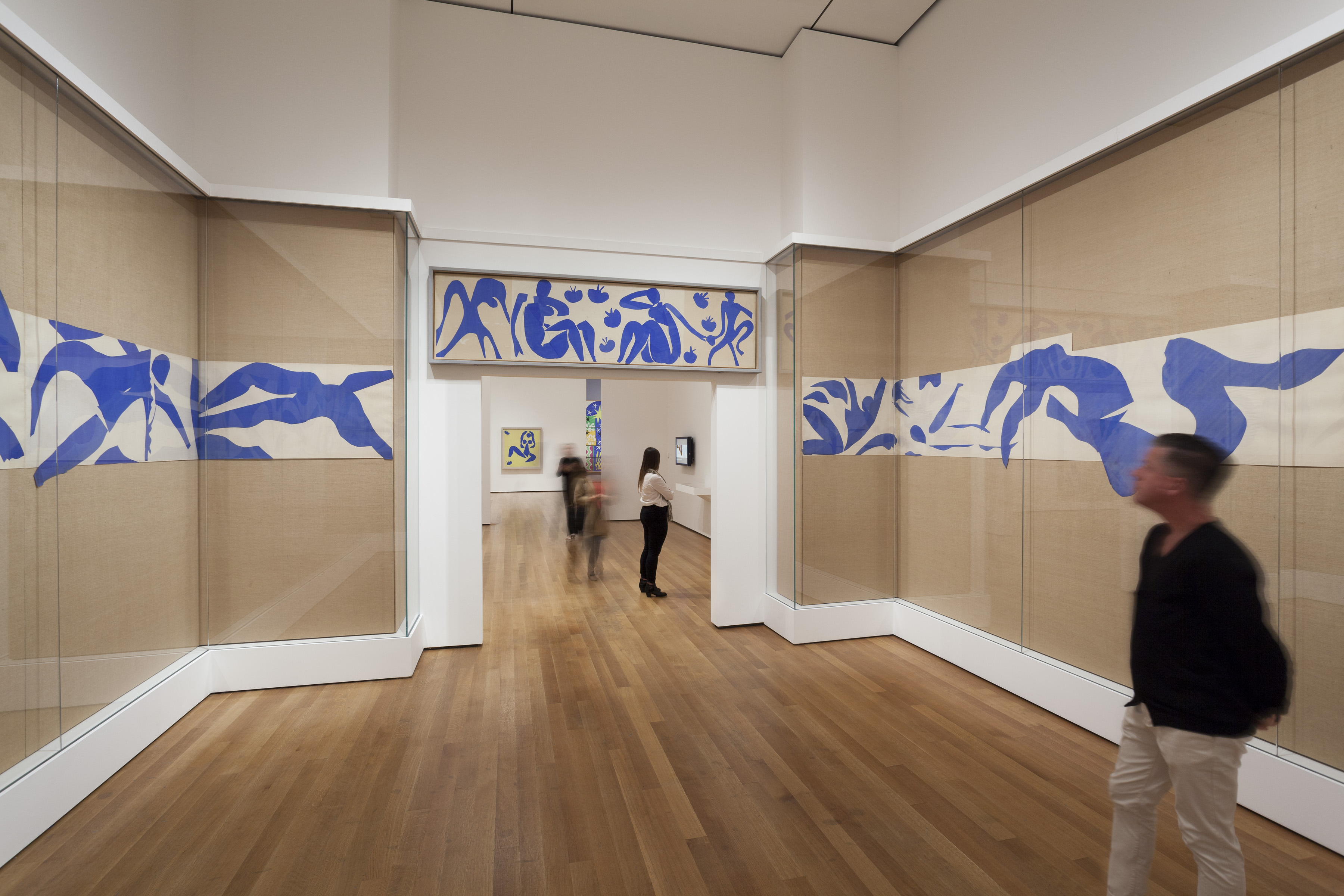
Matisse had created the piece to put on display in his kitchen in Nice (Which MoMa now owns) in 1952. It is laid out to be a horizontal, wrap-around mural, and MoMa had worked around that problem and translated it to a museum context seamlessly.

No comments:
Post a Comment